
 Copy the shared link
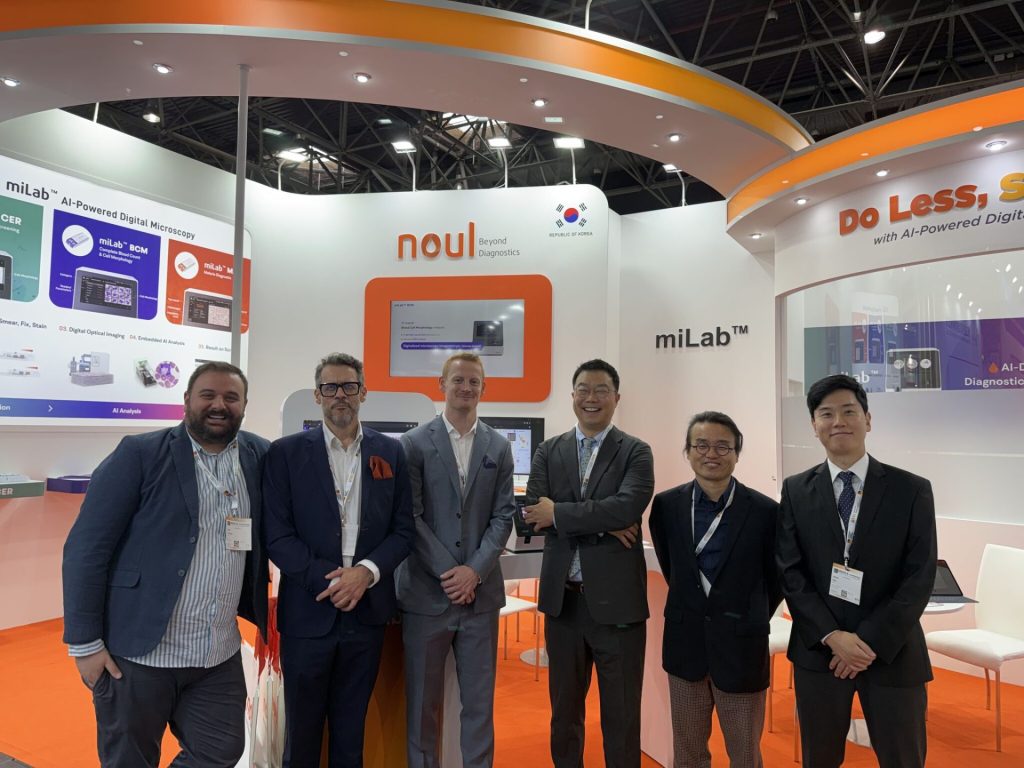
Source: noul
MEDICA 2025 (November 17–20, Düsseldorf, Germany), held under the theme “Meet Health. Future. People.”, offered a clear view of how medical technology, digital healthcare, and data-driven care models are converging at scale. This year’s exhibition became a central stage for discussing how technology can address structural challenges faced by health systems worldwide: workforce shortages, widening diagnostic gaps, increasing complexity in hospital operations, and persistent infrastructure limitations in LMICs.
Against this global backdrop, MEDICA highlighted core technologies shaping the next era of care—including AI-enabled diagnostics, laboratory automation, robotics, remote care models, and connected medical devices. The event brought together technology companies, research institutions, governments, NGOs, and healthcare startups, positioning itself as a trend-defining platform for the future of diagnostics.
Noul’s presence at MEDICA was rooted in the same purpose. As diagnostic environments evolve rapidly, Noul aims to demonstrate how the miLab™ point-of-care digital microscopy platform can address emerging needs and explore collaboration opportunities across countries and institutions seeking more accessible, efficient diagnostic solutions.
Key Diagnostic Technology Trends Observed at MEDICA 2025

Source: MEDICA
MEDICA 2025 highlighted three major trends:
1) Expansion of AI & Generative AI into clinical practice
AI-assisted workflows became one of the strongest technology pillars at MEDICA 2025. Automated interpretation, imaging analytics, and predictive modeling were showcased as tools that enhance—not replace—clinical decision-making. Use cases such as digital twins and AI-powered precision diagnostics illustrated how AI is moving deeper into real clinical workflows.
2) Acceleration of Robotics, Automation, and Assistive Systems
Automation was presented as an essential response to workforce shortages and quality inconsistencies across laboratory settings. Technologies for slide preparation, specimen handling, imaging, and logistics demonstrated how repetitive tasks can be streamlined while reducing operational burden.
3) Rise of Integrated Care and Telemedicine as connected care models
The Telemedicine & Integrated Care zone emphasized a future where hospitals, local clinics, mobile units, and remote reviewers operate as a connected network. Remote diagnostics, mobile clinics, and connected devices were especially relevant for regions with limited access to healthcare, reinforcing sustainable diagnostic access as a major theme.
Together, these trends reflect a global expectation for diagnostics that deliver accuracy, efficiency, and accessibility simultaneously.
How miLab™ Aligns with Global Diagnostic Trends

Source: noul
The miLab™ platform is a digital microscopy-based point-of-care solution combining Solid Staining-based cartridges with automated slide preparation, staining, imaging, and AI analysis. Supporting hematology (blood count & morphology, malaria) and cytology (cervical cancer screening), the platform embodies a unified philosophy: “Do Less, See More.”
1) A structure designed for AI & GenAI-driven reliability
miLab™ delivers immediate results for CBC, blood morphology, malaria, and cervical cytology directly at the point of care through on-device AI. Because the AI operates independently of network connectivity, diagnostic performance remains consistent across environments—an essential requirement for global health settings.
A defining feature of miLab™ is its Solid Staining-based cartridge. Unlike liquid reagents, solid staining reduces degradation risks and stabilizes staining quality. This ensures that each slide is produced with consistent concentration and volume, maintaining uniform image quality. Since AI performance fundamentally depends on image consistency, miLab™ embeds quality standardization from the manufacturing stage.
2) End-to-end automation that aligns with assistive system trends
The automated workflow—from slide creation to staining, imaging, and AI interpretation—replaces multiple manual and error-prone steps typically found in laboratory environments. By minimizing reagent handling, slide variability, and operator-dependent processes, miLab™ reduces operational workload while enabling consistent diagnostic results.
3) A connected, point-of-care experience built for Integrated Care and Telemedicine
The miLab™ viewer allows results to be reviewed both online and offline, supporting diverse care environments including hospitals, local health centers, independent clinics, mobile medical units, and outreach programs. Its compact all-in-one design suits facilities with limitations in power, space, or staffing, making it a practical tool for improving diagnostic accessibility at scale.
By integrating sample preparation, imaging, and AI-driven interpretation into a single clinical flow, miLab™ represents a structural shift toward a unified point-of-care ecosystem.
Insights and Feedback from MEDICA 2025

Source: noul
A major point of resonance at MEDICA 2025 was the practical convenience and stability of the Solid Staining-based cartridge system. Visitors consistently reacted positively to the minimal preparation required and the reliably high-quality images produced, noting how this ease of use lowers the operational threshold for point-of-care diagnostics. Many institutions viewed the automated workflow as a meaningful simplification of traditional laboratory processes, reducing unnecessary steps and supporting more consistent performance across users.
Stakeholders from LMICs, regional hospitals, and decentralized care settings were particularly drawn to the on-device AI, which enables analysis without network connectivity—a direct response to real-world infrastructure constraints. The compact all-in-one design and minimal maintenance needs further underscored its suitability for facilities with limited staffing, space, or power stability.
Scientific and institutional evidence also played a key role in building trust. miLab™ CER and miLab™MAL being referenced in UNITAID reports provided a strong validation basis, and miLab™ MAL’s microscopy-comparable sensitivity and specificity—proven in both endemic African settings and European non-endemic regions—was well received. Likewise, miLab™ BCM’s high correlation with major CBC analyzers across diverse patient groups, including infants, reinforced its analytical reliability.
Noul’s momentum in Europe was further strengthened through the NRW government’s pitching session, which spotlighted miLab™’s technological strengths and global scalability. The session led to repeated booth visits and follow-up meetings, and for many attendees, the combination of innovation, independent validation, and early regional engagement positioned miLab™ as a credible solution with meaningful potential across varied healthcare environments.
MEDICA 2025: A Clear Validation of miLab™’s Global Potential

Source: noul
MEDICA 2025 demonstrated that diagnostics are moving toward AI-centric automation, connected care networks, and accessibility-driven models. Within this landscape, miLab™ showcased its ability to deliver standardized quality through Solid Staining, intuitive end-to-end automation, and resilient on-device AI. The philosophy of “Do Less, See More” resonated strongly with clinical users seeking streamlined preparation, consistent imaging, and faster decision-making.
Beyond technology, miLab™’s global potential is reinforced by its business foundation. Noul now operates with a dedicated European team, collaborations with major lab chains such as Limbach, distribution agreements across key EU markets, and successful pilots and validation studies with hospitals and institutions worldwide. Together, these form a robust infrastructure for scalable adoption.
As global healthcare continues to evolve, miLab™ stands as a practical, future-ready point-of-care diagnostic ecosystem. For organizations seeking faster, more accessible, and more reliable diagnostics, Noul invite you to explore partnership opportunities with miLab™. The future of healthcare innovation is already underway.