
 Copy the shared link
Source: Shutterstock
Every April 25th, the world observes World Malaria Day — an international awareness day established to raise global attention on malaria and accelerate coordinated action against the disease. This year’s campaign theme, “Driven to End Malaria: Now We Can. Now We Must,” underscores the urgent need for immediate and meaningful action in the fight against malaria.
World Malaria Day was officially designated by the World Health Assembly in 2007. Its origins trace back to 2001, when African nations established “Africa Malaria Day” as a unified response to the disease threatening their populations. As international solidarity around malaria elimination grew, WHO expanded this observance into a global commemoration.
More than two decades later, malaria remains one of the world’s most serious infectious diseases. World Malaria Day continues to serve as a critical platform to encourage governments, international organizations, and the private sector to invest more actively in prevention, diagnosis, and treatment — while providing an opportunity for countries and institutions to share progress and strengthen international partnerships.
The Global Malaria Landscape
Source: Shutterstock
As of 2024, there were an estimated 282 million malaria cases and 610,000 deaths worldwide — an increase of approximately 9 million cases compared to the previous year. These figures are a clear reminder that malaria is far from a disease of the past.
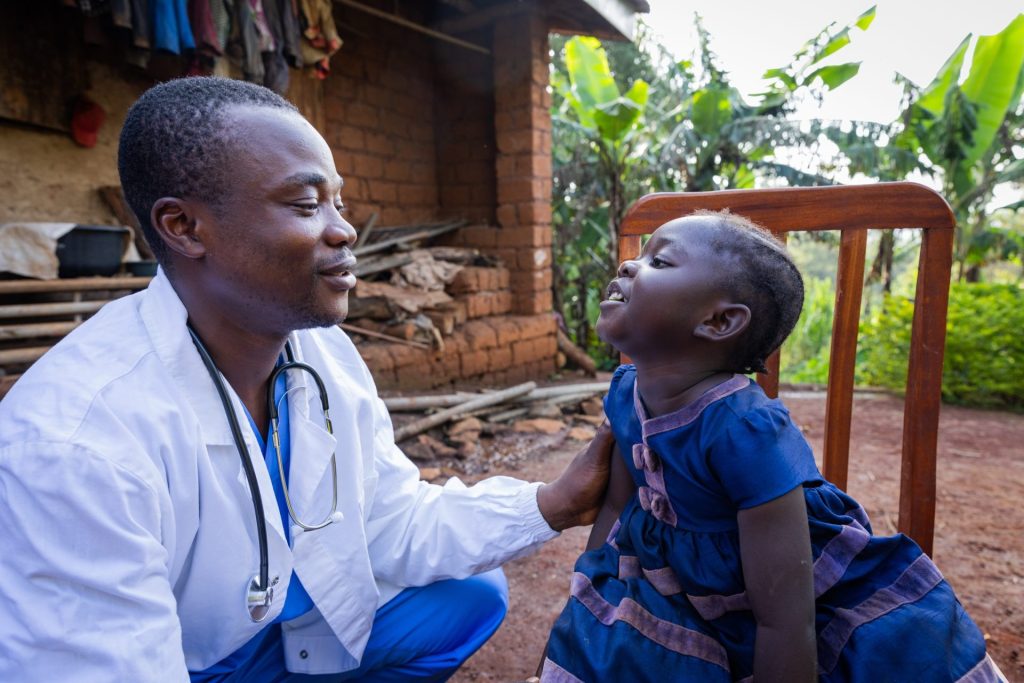
The burden remains heavily concentrated in specific regions and populations. WHO African Region accounts for 95% of all malaria cases and deaths globally, with 75% of those deaths occurring among children under the age of five. Pregnant women are also classified by WHO as a high-risk group, making malaria a disease that continues to disproportionately affect the most vulnerable.
There has been meaningful progress. Seventeen African countries have introduced malaria vaccines into routine childhood immunization programs, and Rwanda achieved an 85% reduction in malaria cases between 2019 and 2023 — demonstrating what is possible when investment and implementation come together.
Yet structural challenges remain. Global malaria funding stands at approximately $4 billion — less than half of WHO’s $8.3 billion target. Without closing this funding gap, even the most advanced vaccines and diagnostic tools will struggle to reach those who need them most. This is precisely why this year’s campaign, “Driven to End Malaria: Now We Can. Now We Must,” is more than a slogan — it is a call for concrete, sustained action.
Why Malaria Remains So Difficult to Eliminate
Source: Shutterstock
Despite decades of global effort, malaria remains an unresolved challenge. This difficulty lies not in any single factor, but in a complex interplay of biological, environmental, and health system barriers.
From a biological standpoint, the Plasmodium parasite presents a formidable challenge. Its life cycle spans both the liver and blood stages, and certain species — such as P.vivax — can remain dormant in the body and relapse after treatment. Growing resistance to antimalarial drugs further complicates treatment, increasing the risk of reinfection and recurrence even after intervention.
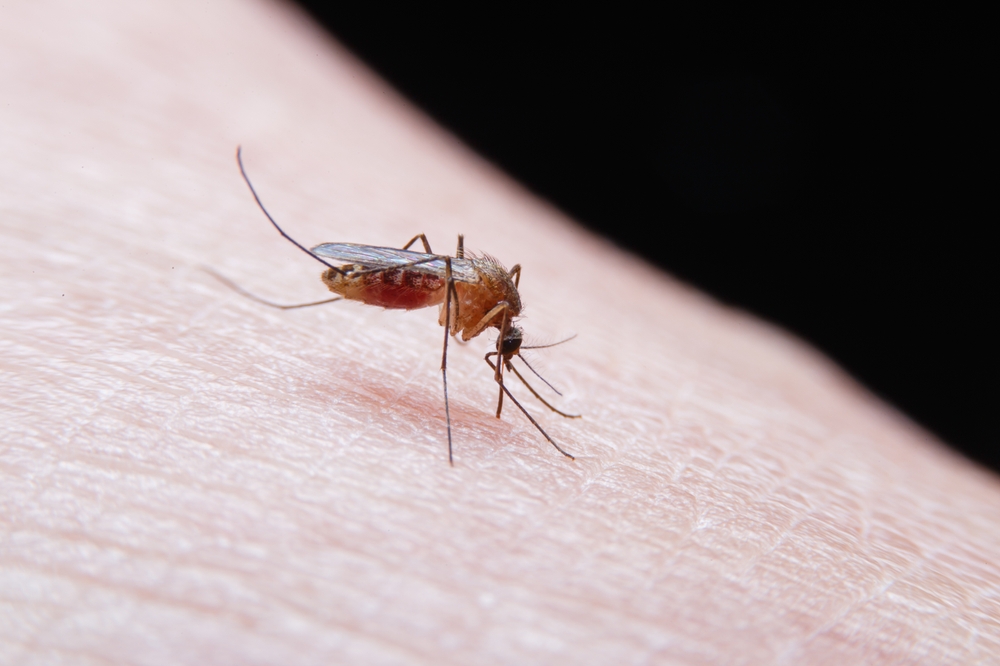
Environmental factors add another layer of complexity. The Anopheles mosquito, the primary vector of malaria transmission, is highly sensitive to temperature, humidity, and rainfall — enabling year-round transmission across tropical and subtropical regions. Climate change is expanding the mosquito’s habitable range, increasing transmission risk in areas where malaria was previously under control.
Health system factors are particularly pronounced in low-income countries. Shortages of medical infrastructure and skilled personnel make accurate diagnosis difficult, while gaps in access to preventive tools, medicines, and diagnostics deepen regional disparities. Insufficient global investment continues to entrench these structural barriers, making it difficult to establish systematic early detection, treatment, and prevention at scale.
Given the complexity of these challenges, addressing malaria requires a multi-faceted approach. Among the critical intervention points diagnostics stand out as the foundation of effective treatment and prevention — and a core pillar of health system strengthening.
An Innovative Diagnostic Solution for Malaria Elimination: miLab™ MAL
Source: noul
One of the key obstacles to malaria elimination is the structural limitations within current diagnostic pathways. In many high-risk settings, rapid diagnostic tests (RDTs) are the primary tool due to their speed and accessibility — but they have known limitations in species differentiation and diagnostic accuracy. Conventional microscopy offers greater precision, but requires skilled personnel and established infrastructure, limiting its reach. These gaps directly affect the timeliness and accuracy of clinical decision-making.
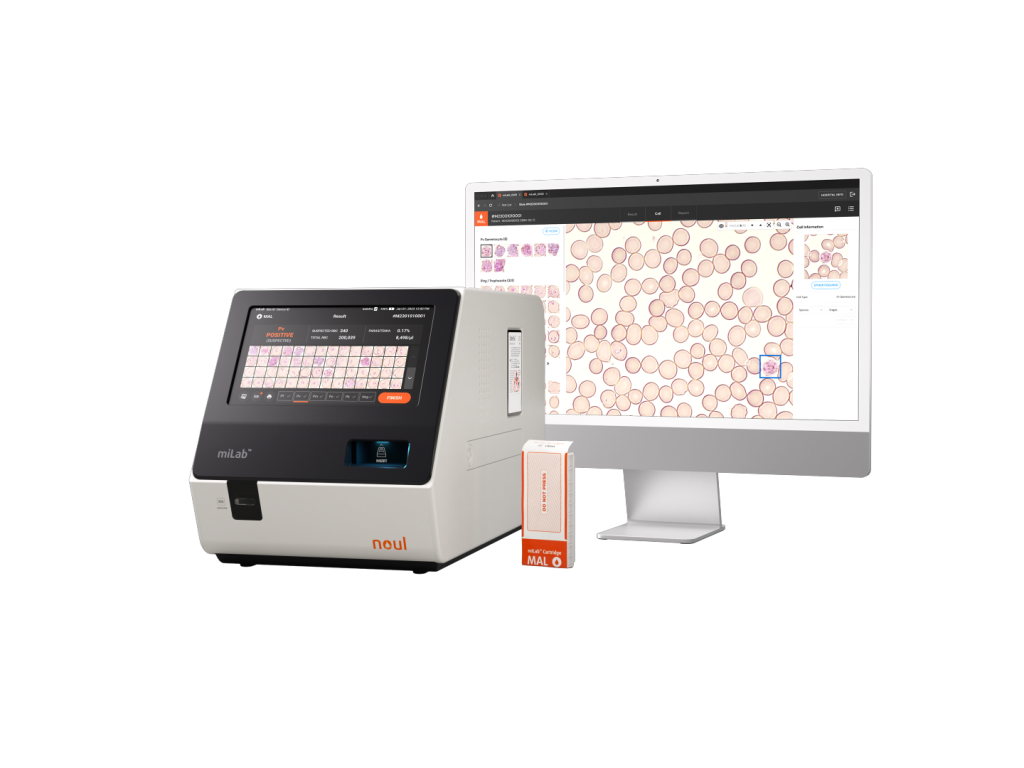
miLab™ MAL addresses these challenges through Noul’s proprietary solid-staining technology, enabling the full diagnostic workflow — smearing, staining, imaging, and analysis — to be completed automatically with a single cartridge. Without the need for separate reagents of complex equipment, standardized testing becomes feasible in settings where traditional diagnostics are not viable, reducing both infrastructure dependency and reliance on specialized personnel. Furthermore, the AI-powered analysis automatically detects abnormal cells and differentiates between P.falciparum (P.f) and P.vivax (P.v) — two species that require different treatments — providing a clear basis for informed clinical decisions. By minimizing variability across operators, miLab™ MAL delivers consistent diagnostic quality regardless of setting.
With 95% of malaria cases occurring in the African Region, diagnostic solutions must go beyond centralized hospitals — reaching patients at the point of care, where the need is greatest. miLab™ MAL is designed precisely for this reality: its compact form factor and cartridge-based system make it well-suited for decentralized healthcare environments where infrastructure is limited.
The innovation behind miLab™ MAL has been recognized on the international stage, including its mention in the UNITAID report as an innovative malaria diagnostic product. Today, miLab™ MAL is actively used in more than 30 countries worldwide — a testament to its real-world reliability and clinical value.
Beyond Malaria: Noul’s Commitment to Global Health Equity

Source: Shutterstock
Noul’s journey began with a clear observation: in regions with the highest malaria burden, conventional diagnostic methods — heavily dependent on reagents, infrastructure, and skilled personnel — were simply not accessible to those who needed them most. In response, Noul developed a technology platform capable of delivering accurate diagnostics with minimal infrastructure requirements. miLab™ MAL was the first product to emerge from this vision, and it is now deployed across more than 30 countries as a trusted solution for malaria diagnosis.
Noul’s ambition extends beyond malaria. miLab™ BCM brings full automation to complete blood count (CBC) and morphology testing on a single device, while miLab™ CER improves access to cervical cancer screening through an AI-powered digital cytology solution. Across all three product lines, Noul applies the same underlying philosophy: to bridge the diagnostic gap for patients who lack access to quality healthcare due to shortages of skilled personnel and infrastructure. The disease may differ — the problem does not.
Through the miLab™ platform, Noul is working toward a future where high-quality diagnostics are accessible to everyone, everywhere. This is how Noul contributes to the realization of Global Health Equity.
To learn more about Noul’s miLab™ solutions, visit the link!