 Copy the shared link

Source: google
EU environmental regulation for medical devices has tightened alongside broader restrictions on hazardous substances and resource circulation across the electronics industry, and medical devices are no longer the exception. RoHS restricts ten hazardous substances — including cadmium, lead, and mercury — in electrical and electronic equipment; REACH requires chemicals manufactured or imported above one tonne per year to be registered, evaluated, authorized, and restricted by risk; and WEEE mandates the collection and recycling of waste electrical and electronic equipment.
All three are already in force, and on August 12, 2026, the Packaging and Packaging Waste Regulation (PPWR, EU 2025/40) takes effect, covering hazardous substances, recyclability, and extended producer responsibility (EPR) in packaging. Because medical devices combine electronic components with chemical reagents, they face all four regulations at once — a rare combination.
These aren’t hypothetical risks. In Germany in 2018, a single consumer inquiry through an SVHC information-request app led one company to test its own product, confirm a hazardous plasticizer (DEHP), and pull it from shelves immediately. In France in 2025, seven companies were penalized for failing to register packaging under EPR, facing fines of up to €10,000 per violation plus daily penalties of up to €5,490 — proof that environmental non-compliance already halts real business.
IVDD (98/79/EC) or IVDR (2017/746) certification and CE marking prove performance and safety, but no longer account for a supply chain’s full sustainability. The real question isn’t whether a company complies with regulation — it’s whether it was building sustainably before regulation demanded it. That shift is becoming the new standard across the medical device industry.
Beyond Compliance: Choosing Sustainability First
Source: google
Noul supplies devices, cartridges, and reagents into Europe, where EU environmental regulation requires it to meet RoHS, REACH, WEEE, and PPWR at once. Its miLab™ platform is a digital microscopy system that automates the full diagnostic process — sample prep, staining, imaging, AI analysis, and reporting — using only a device and a disposable cartridge. On one platform, it spans miLab™ MAL for malaria, miLab™ BCM for blood cell count and morphology, and miLab™ CER for cervical cancer screening.
Noul treats meeting these four regulations not as a defensive reaction, but as an extension of a technological direction it has pursued for years. Its core technology was designed from the start to use fewer resources and leave less waste — a principle that predates the recent tightening of EU environmental regulation.
In fact, IVD devices sit under a more lenient timeline than general electronics: RoHS deadlines for IVD apply later (RoHS 2: 2013 for electronics vs. 2016 for IVD; RoHS 3: 2019 vs. 2021), with separate exemptions for components lacking validated alternatives. Even with that leeway, Noul adopted sustainable technology proactively — a company-wide principle built into product design, not one department’s initiative.
Sustainability Built Into the Product: NGSI, a Solid-State Staining Technology
Source: noul
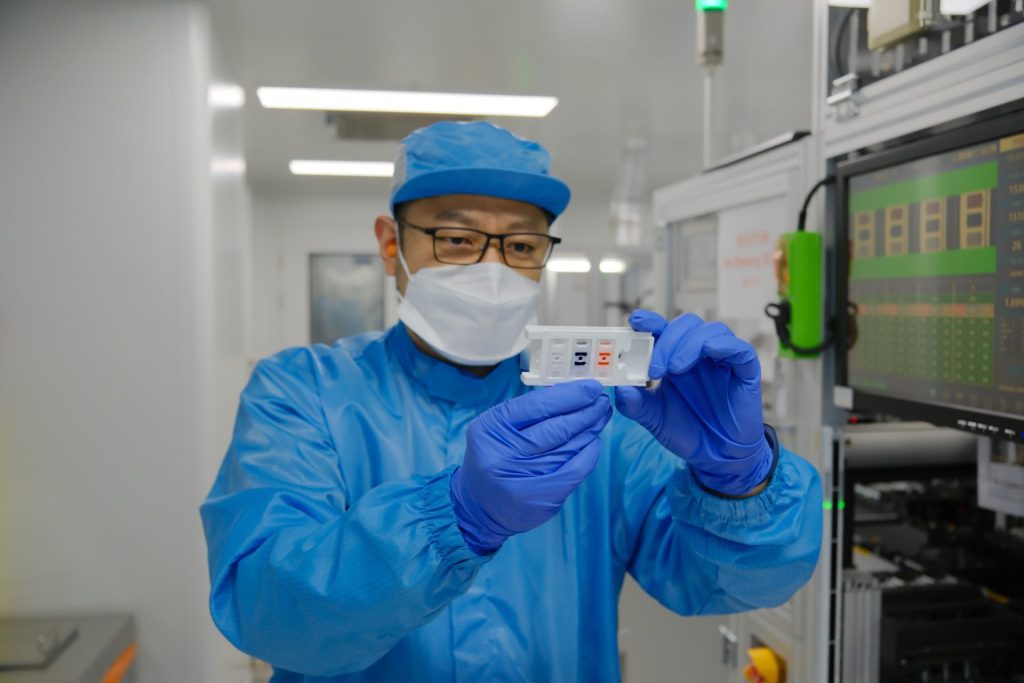
In diagnostics, staining makes cells too subtle for the naked eye readable under a microscope. miLab™ MAL and BCM stain a blood smear from a single drop of fingertip blood; miLab™ CER stains a liquid-based cytology (LBC) slide from the cervix. Traditional methods like Wright-Giemsa and H&E require multiple liquid reagents and a multi-step process of dipping, washing, and drying — accurate, but a source of continuous chemical waste and wastewater for over a century.
Noul’s NGSI (Next-Generation Staining & Immunostaining) compresses this liquid process into a single solid, hydrogel-based stamp. Pressing a reagent-loaded hydrogel patch onto the slide completes staining — no dipping, washing, or drying. This cuts reagent volume by up to 99%, produces no wastewater, and removes the pumps and plumbing liquid staining requires, reducing hazardous waste as well. Applied across every staining step of the miLab™ platform — MAL, BCM, and CER — its environmental benefit scales with every new diagnostic area.
These results are validated in peer-reviewed journals: ACS Applied Materials & Interfaces (2021, 13(19):22124–22130) (PubMed) and Frontiers in Bioengineering and Biotechnology (2023, 11:1292785) (PMC), the latter confirming the method is safer and more environmentally friendly than conventional staining.
Values Are Proven Through Execution, Not Declaration
Source: noul
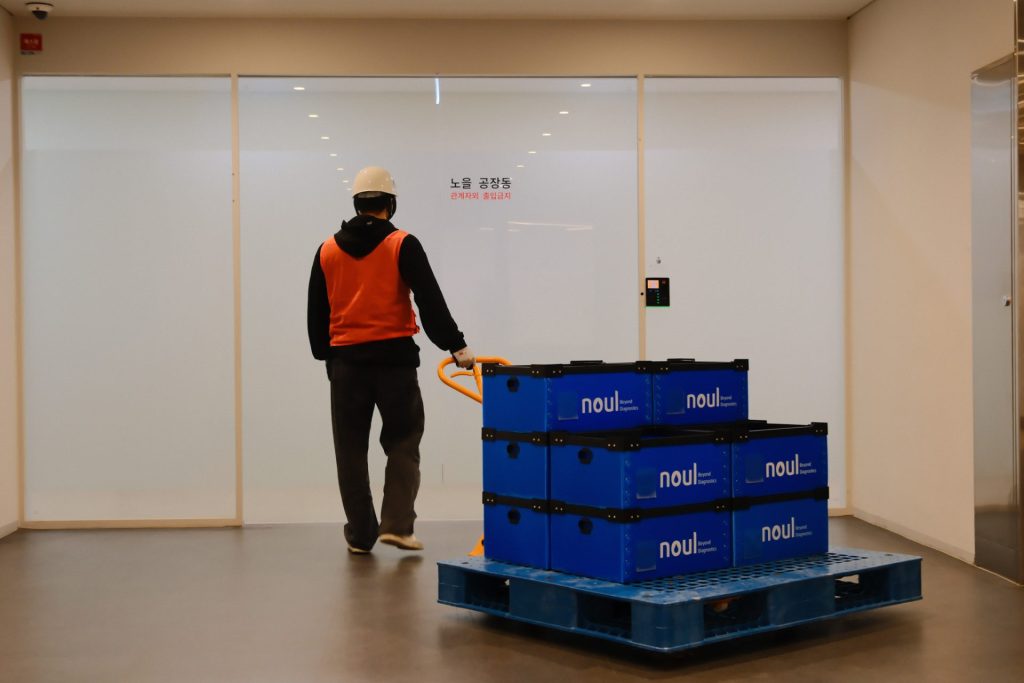
This commitment to EU environmental regulation for medical devices doesn’t stop at a statement of intent. CE marking, technical documentation (TD), a Declaration of Conformity (DoC), and a European Authorized Representative are all in place, so evidence is ready the moment a customer asks. Beyond that, standard operating procedures retain technical documentation long-term, track design changes through formal change control, and route any issue through incident reporting for immediate action — so certification stays a living system, not a document filed away.
For PPWR, effective August 12, 2026, Noul registered under EPR ahead of time in several of the European countries where it plans to sell, minimizing any risk of supply disruption once the regulation takes effect. REACH centers on monitoring rather than reporting, so Noul continuously tracks updates to the SVHC candidate list. For Noul, compliance is how sustainability gets proven — values and systems aren’t separate.
EU Environmental Regulation for Medical Devices: The Global Value Noul Delivers
Source: noul
Noul treats what comes after CE marking — environmental compliance, sustainable technology — as an extension of product reliability, as tied to supply stability as performance itself. Technology that cuts reagent use and waste, backed by this compliance system, holds the same value in resource-limited settings as in Europe; miLab™ MAL is already used for malaria diagnosis in more than 30 countries. That foundation lets Noul’s sustainability value extend beyond Europe to the global market.
EU environmental regulation isn’t a one-time task — it grows with the market, from SVHC list updates to EPR registration in new countries — and Noul manages it as an ongoing system. A sustainably built diagnostic solution is becoming as much a baseline as performance itself, part of the trust customers gain when they adopt miLab.
Curious about a diagnostic partner that was practicing sustainability before regulation required it? Get in touch with miLab today.